
Service
ERP Evaluation – free, independent, built around your processes
Before we talk about a system, we talk about your processes. Cloudmaven works with you to analyze your requirements, jointly develop your future IT architecture, and only then independently recommend which ERP system fits best free of charge, with no sales agenda for a single product.
What makes our evaluation different
There are plenty of ERP evaluation consultancies. Almost all of them stop at a written comparison of vendors against a requirements list. We don’t, for one simple reason: we are an actual implementation partner for several of the platforms we evaluate, so we know from hands-on delivery experience what really matters once a project starts not just what looks good in an RFP.
That cuts both ways. In many cases, it means we can save you the cost and time of a long, formal pre-evaluation altogether: once we understand your industry and your processes, the realistic shortlist of systems is often obvious quickly. We won’t manufacture a longer process than the decision actually needs.
Where your situation is genuinely complex, we go the other direction deep. We build a real stock take of your current processes and design your future IT architecture with you in detail: systems, interfaces, responsibilities, reporting. No purely independent consultant can take this to the same depth, because the next step is building an actual proof of concept grounded in that architecture, backed by our own delivery experience not a theoretical fit assessment. At that point, choosing the system is less about comparing feature lists and more about confirming which platform can genuinely deliver the architecture and processes we’ve already designed and proven together.
Why an independent evaluation is necessary in the first place
Most companies choose their ERP system either by gut feel, by whichever sales conversation was most convincing, or by whatever a single vendor is promoting loudest. The result: expensive wrong decisions that only surface after go-live when switching is most expensive.
Cloudmaven reverses that order. We don’t start with the software; we start with your finance and business processes. Only once we’ve jointly understood how your company works today, and how it should work in three to five years, do we talk about specific systems.
How we work
Our approach is built on the Cloudmaven ERP Methodology and its Target Operating Model (TOM) Framework the same approach we use on large customer projects:
1. Process and requirements analysis We capture your current finance, sales, purchasing and operations processes together with the relevant business functions not just with IT.
2. Joint target architecture (Target Operating Model) We develop with you what your IT and process landscape should look like in future: systems, interfaces, responsibilities, reporting requirements.
3. Structured vendor comparison Based on your concrete requirements, we assess suitable systems from our own portfolio (NetSuite, Business Central, Finance & Operations, Everest, SAP S/4HANA Cloud) and, where relevant, beyond it.
4. Documented decision package You receive a traceable overview of strengths, limitations and investment scope per option not a verbal recommendation, but a document you can discuss internally and with other stakeholders.
5. Optional: implementation If you decide to go ahead, we support you through our phase model Initiate, Analysis/Design, Build, Validate, Deploy with the same team that ran the evaluation.
What you walk away with
Deliverables that are valuable for your business independent of which system you ultimately choose.
A process and requirements map Valuable for your business independent of the system question.
A target IT architecture (Target Operating Model) Showing how systems, data and processes should work together in future.
A structured vendor comparison With strengths, limitations and investment scope per option, the same format we use in our own customer projects.
A clear recommendation That you can follow and question, rather than one you have to take on faith.

Why is the evaluation free and how independent is it really?
Two honest answers we should give directly on the page, rather than leaving prospects to figure them out themselves:
Why free?
We make our money through implementation, not through the evaluation. The analysis phase is free and non-binding you’re not obligated to carry out the implementation with us afterwards. You receive all the documents we produce along the way: current-state process charts and our recommendations for your future processes. You’re free to take these results to a different implementation partner at any time and start implementation immediately, because you’ll be working from a fully developed proof of concept not starting from scratch.
How independent is the recommendation, really?
Honestly: we are an implementation partner for several ERP platforms, and we earn from the implementation regardless of which of the five platforms you choose. That’s why we document our assessment in a traceable way with concrete strengths, limitations and investment scope per option so you can check our recommendation yourself instead of having to take it on faith. Where a requirement is better solved outside our portfolio, we say so openly too. And if you choose to move forward with a different partner, we hand over everything we’ve produced documents and working materials to them.
The platforms we know best
Deep expertise across five core platforms and beyond, when your requirements demand it.
Oracle NetSuite For software, services and trading companies with recurring revenue.
Microsoft Dynamics 365 Business Central For the mid-market within the Microsoft ecosystem.
Microsoft Dynamics 365 Finance & Operations For complex, global enterprise organisations.
Everest Systems For companies that want a particularly modern, AI-native architecture.
SAP S/4HANA Cloud, Public Edition For companies with SAP history or deep manufacturing/industrial requirements.
If your needs go beyond these five platforms, we also bring in other vendors for assessment such as Odoo, Sage, Infor, Unit4, Campfire, Rillet, Dualentry and others.

Why Cloudmaven
We see ourselves as more than a technical implementation partner we bring deep knowledge of strategy, company scaling and accounting. Our focus is always on the solution, not on a single product.

Cloudmaven in Figures
16+
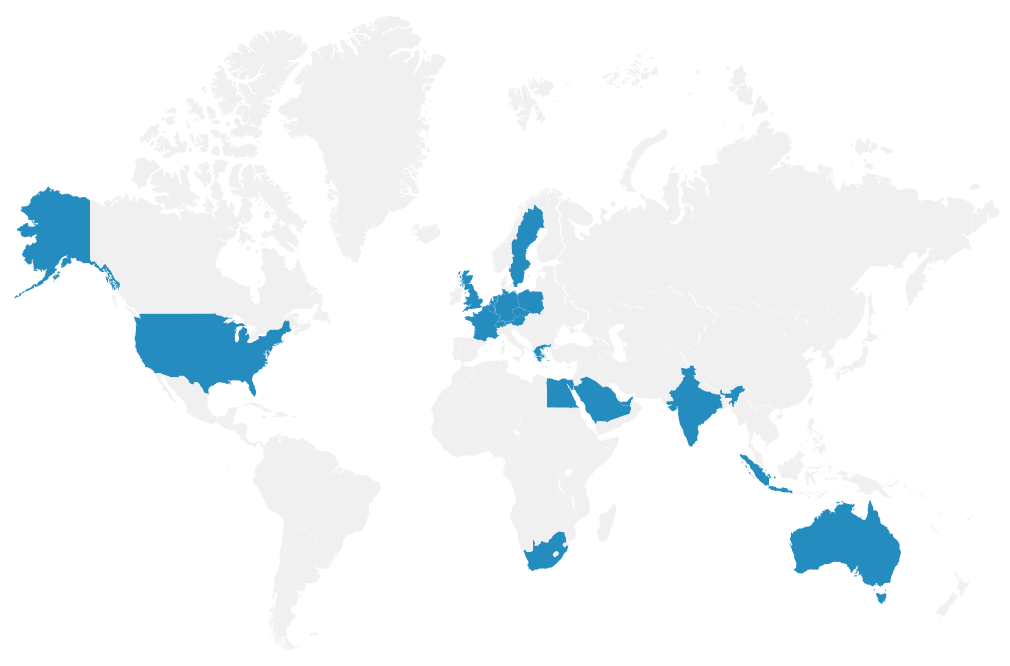
Locations worldwide (Europe, EMEA, America, Asia)
30+
Countries in which we operate
120+
ERP and EPM employees
350+
satisfied customers
400+
Successfully implemented projects
FAQs
What does the ERP evaluation actually cost?
The process analysis, the joint development of your target IT architecture, and the vendor comparison are free and non-binding for you. Cost only arises once you decide to move forward with an implementation.
Am I obligated to implement with Cloudmaven afterwards?
No. You receive a documented recommendation and can freely decide whether, and with whom, you pursue implementation.
How independent is the recommendation if Cloudmaven earns from the implementation?
We’re transparent about it: we earn from implementation, not from the evaluation itself. That’s why we document our assessment in a traceable way, with strengths, limitations and investment scope per option, so you can verify it yourself.
What makes Cloudmaven’s evaluation different from other ERP consultants?
Most ERP consultancies stop at a written comparison. Because we’re an actual implementation partner, we go further: we build a real proof of concept grounded in the target architecture we design with you — something a purely independent consultant, without hands-on delivery experience, structurally can’t do.
How long does an ERP evaluation take?
Duration depends on the size and complexity of your organisation. We’ll give you a realistic timeline in the first intro call.
What is the Target Operating Model (TOM)?
The Target Operating Model describes how your processes, systems, data and responsibilities should work together in the future. It’s the foundation on which we then select the right ERP platform — rather than treating the system question in isolation.
Do you only compare your own five platforms?
Our deepest expertise is in NetSuite, Business Central, Finance & Operations, Everest and SAP S/4HANA Cloud. Where your requirements go beyond that, we bring in other vendors for assessment as well — for example Odoo, Sage, Infor, Unit4, Campfire, Rillet or Dualentry.